Thursday, June 29, 2006

Council Cycling Update: Camden

Following my article evaluating local council cycling websites, I thought I'd start the ball rolling, and inform a few councils of what's being written about them.

I picked out the specific champions for transport and cycling, and sent them this message:

Dear (person), London Borough council websites have been compared and judged against each other, regarding the online services provided for cycling in your borough.

The full ratings list can be found here: http://cycling-london.blogspot.com/2006/06/all-london-borough-councils-cycling.html

A number of new ideas and suggestions are presented at the bottom of the web page, for your consideration.

Kind Regards, Urban-Commuter

So far I have had ZERO responses!

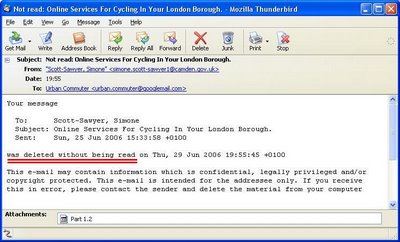
Rejoicing after reading the welcoming, promising, Camden council site, spouting its pledge: "at your service", their response deserved a special mention!:


Deleted without being read! Love it!

Stumble Upon Toolbar

Monday, June 12, 2006

Powerband

There is a feeling in my legs, at a certain high rpm, when the muscles are glowing and the heart is pumping, where I seem to be able to magic up a boost of energy from expended resources.

Perhaps it's like how an afterburner works on a jet? Something with lactic acid, who knows...

My powerband phenomenon only occurs rarely. Usually when energy supplies are starting to dwindle, & a last hard push, to get up a hill or such, suddenly rewards me with a band of power in my legs, spinning turbocharged as if I had an energy drink intravenously fed straight to the muscle!

I don't think I've experienced it for over a year or so, probably because my developments commuting are not in speed, but mental awareness & roadcraft.

Surprisingly I experienced the power band this morning, and went pelting up hill. However, I think I found out the source of my powerband: The wind. X-)

Stumble Upon Toolbar

Thursday, June 01, 2006

All London Borough Councils - Cycling Online

London has 33 boroughs. Every council has a website. Not every council likes cycling!

Source

In this post we look at the hugely different coverage of cycling, within each London borough's website.

Every council website was evaluated on their online local cycling information, content, real actions reported, and statistics. An overall score was then generated, of either: good, fair, or poor. Unfortunately, the results were often negative, and an uber-low category entitled "crap" had to be created!

Note that this rating is PURELY on website content representing cycling, NOT on the physical cycle facilities or traffic schemes in the borough.


London Borough Websites - Rated for Cycling Content:

Barking - (good)
Barnet - (Poor)
Bexley - (poor)
Brent - (poor)
Bromley - (poor)
Camden - (fair)
City - (fair)
Croydon - (poor)
Ealing - (poor)
Enfield - (crap)
Greenwich - (poor)
Hackney - (poor)
Hammersmith - (fair)
Haringey - (poor)
Harrow - (poor)
Havering - (crap)
Hillingdon - (crap)
Hounslow - (poor)
Islington - (good)
Kensington & Chelsea - (fair)
Kingston - (fair)
Lambeth - (poor)
Lewisham - (fair)
Merton - (poor)
Newham - (poor)
Redbridge - (poor)
Richmond - (crap)
Southwark - (good)
Sutton - (poor)
Tower Hamlets - (poor)
Waltham Forest - (good)
Wandsworth - (poor)
Westminster - (poor)


Overview - Trends

Researching all the London Borough websites I picked up a theme running throughout: - Plans, Plans, Plans.
Fine, I appreciate there needs to be a final direction to head towards. But equally important, is to read about what positive actions boroughs HAVE completed, with all that money us taxpayers gave you!

Some borough councils may actually have good physical cycle facilities, but any potential new cyclist browsing a basic and uninformative council webpage on local cycling, might not find any help, encouragement, or useful information there. The true extent of local riding locations, direct routes, and facilities may remain hidden, due to a poor council website on cycling.


Good, Is Not Good

The ratings judge each council's cycling web pages against its relative peers. So a "good" rating here is nothing special, given the general poor range of information available across most borough websites reviewed.

Many of the above council links have contacts for your local cycling officer or traffic planner, if you want to contribute your input.


Untapped Social Advantages

Potential cyclists make up a huge dormant user-group (or in fancy talk: "customer"), for borough councils to satisfy. Because National Statistics estimate there are 0.82 bicycles per household. Almost as high as cars, which average 1.04 cars per household.

The social implications could be huge. If potential bike-riders were encouraged by councils to compliment cycling in to their lifestyle, the list of improvements would be massive. E.g. Reduced heart disease, happier healthier citizens, reduced isolation (in cars), safer roads, reduced fatal & serious injuries, reduced pollution, motivated & fit employees, less sick days, and so on...


What Do Council Websites Need To Improve?

1/. Show me where all the cycle routes are in your borough. If the council doesn't know where they are, chances are the paths will be poor quality surfaces, blocked by overgrowth, dis-jointed unconnected cycle routes, filled with broken glass.

2/. How much resource (money and employees) did the borough put in to cycling last year? (Route maintenance / Cycle network expansion / Priority traffic safety schemes / Secure cycle parking facilities / Skills training / Education / Traffic Speed Reduction Zones / Cycle lane & path sweeping / etc.)

3/. Do you know if cycling clubs or safety groups already exist in your area? Do you help promote these clubs in your community? Have you talked to them?

4/. Do you run informal opinion polls for consultations or feedback to specific local traffic issues, e.g. on the website: "I think the effect of the recent redesign at abc road is: a) Now safer, b) Now more dangerous c) Unchanged.

5/. How risky will it be for me to cycle in your borough? Show me the cycle related accident statistics including; who (risk groups), where (accident blackspots for cyclists?) & when (seasonal? daylight related?).


Technorati Tags: / /

Stumble Upon Toolbar

Sunday, May 21, 2006

Where Do London's Cyclists Live?

Cyclists are seen on the roads, making good progress with their high average speed in London. But where do they come from?

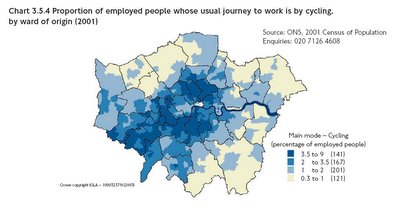
An interesting insight to such questions, is provided by the Office for National Statistics (ONS) 2001 Census results below:
Headlines

The results show a ringed zone of boroughs surrounding central London, where a higher percent of employed people choose to commute by bicycle, as their predominant mode of travel.

The largest cluster away from central London, appears across South West London.


Comments

From the swarms of cyclists in the city, it is easy to assume all routes are destined for central London. This is a limitation of these ONS results - It conveys only the starting point, i.e. Where the cyclists live. Journeys might actually travel west to south, north to north, west to north, or wherever. Not necessarily in to central London.

As at 2001 the biggest percentage noted (of employed commuters cycling,) was only 9% in this survey. This is roughly 1 in 10 people employed. I think this figure will be dramatically improved in the next Census results.

Can you imagine if this statistic was flipped on its head and 9 in 10 people commuted by cycle, things would be a lot quieter, safer, and healthier than they are now.

Judging by the areas on the diagram, typical distances cycled could be roughly 5 - 10 miles each way, as a guestimate.


Rich, Successful, Bike Commuters

South West London enjoys notably more cycle commuting residents than the other compass points, which raises a few questions: Why are two-wheeled journeys to work more popular from the South West of London? Are there amazingly good cycle facilities in South West London? Or is there a link between wealth or socio-economic groups, and the popularity of cycling...?

A report by the AA called "Cycling Motorists," also referred to here, investigated attitudes on the roads in 1993. One of the findings helps us answer our last question:

"Those in the higher income groups are more likely to cycle."

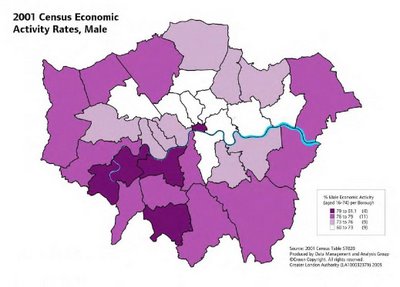
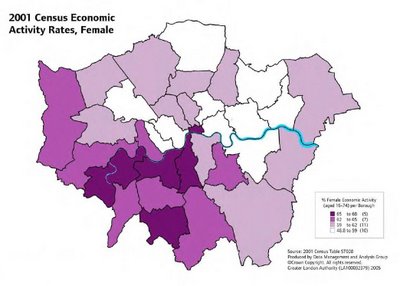
1993 was a long time ago, so how about some more up to date evidence: The 2001 Census below, charts the "economic activity" of London Borough residents. This is the number of people in work, (or not currently in work, but able to work within 2 weeks) living in each London borough. The results below, match the South West's high economic activity, with corresponding areas of high cycle commuting shown above.


Technorati Tags: / / /

Stumble Upon Toolbar

Google Search